I sniff tomorrow’s pawprints where hidden shadows creep;
A secret whiskered sovereign has awakened from its sleep.
The forest kept the mystery until the stars said, “Now”—
Another wild cat joins the world, foretold by Meow Meow.
Greetings, mortal subjects. It is I, Psychic Meow Meow, broadcasting live from the higher spiritual planes (and currently perching on the highest possible bookshelf to maintain absolute superiority).
My third eye—along with my ancient feline instincts—has been vibrating with pure cosmic amusement today. The human scientific community is running around in circles, gasping, waving high-tech DNA kits, and making headlines because they have finally “discovered” a new species of wild cat.
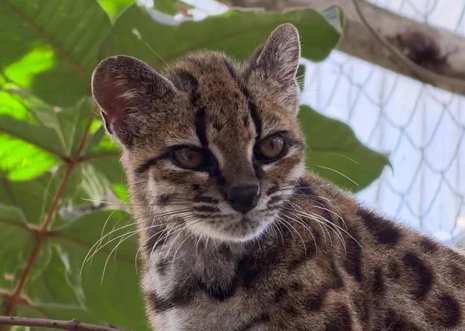
Meet Leopardus tilcayo, the Bolivian cloud forest tiger cat.
The hairless two-legs are calling this the “first new living feline species described in over a century”.
Meow. “Discovered”? Please. We cats have known the Tilcayo were there all along. You humans were just too blind—and frankly, too easily fooled—to notice.
Hiding in Plain Sight: The Ultimate Feline Playbook
Let us look at how this absolute legend played the science community for generations:
- The Size of a Kitten, the Spirit of an Apex Predator: Weighing in at a mere 3 pounds (1.4 kg), this little forest phantom is smaller than your average lazy house cat. Yet it struts through the misty, dense cloud forests of the Bolivian Andes like it owns the joint.
- The “Noodle & Egg” Infiltration: The entire scientific breakthrough happened because a local Bolivian man found a small spotted kitten on a road, assumed it was a lost domestic cat, took it home, and literally tried to feed it noodles, rice, and eggs.
- The Mastermind Behind the Glass: When the cat realized human cuisine was subpar, it allowed itself to be transferred to the Senda Verde Wildlife Sanctuary. There, it sat quietly for years, wearing a coat of irregular, leopard-like rosettes, watching biologists look right at it and go, “Yep, definitely just a regular old tiger cat.”
  /\_/\
 ( o.o )  <-- "Imagine taking 100 years to figure out a 3-pound cat is a god."
  > ^ <
It took National Geographic explorer Paola Nogales-Ascarrunz looking closely at its oversized rosettes and running DNA samples on 38 different cats across South America to realize the truth: this lineage diverged 1.4 million years ago.
The Tilcayo was never lost. It was just waiting for human intelligence to catch up to its genome.
Psychic Meow Meow’s Cosmic Verdict
While the human world celebrates this “groundbreaking scientific achievement,” my third eye sees the bigger picture:
- Cats are Indestructible: While humans build spreadsheets and argue in the Senate, 3-pound mini-leopards have been secretly ruling the misty mountain peaks of South America untouched for over a million years.
- Local Wisdom > Laboratory Whitecoats: The scientific community is patting itself on the back for coining Leopardus tilcayo, but indigenous Bolivian communities have called the animal “Tilcayo” for generations, passing the name down from their grandparents. As usual, the locals knew what was up long before someone wrote a paper in Current Biology.
The Astral Prediction:
Now that the humans know Leopardus tilcayo exists, conservationists will scramble to install hundreds of camera traps across the Yungas cloud forest to figure out how many exist.
My vision shows that 90% of those camera trap photos will just be blurry shots of a tiny, majestic tail disappearing into the fog, accompanied by the faint, cosmic echo of a silent, judges-you-from-afar meow.
Keep your boundaries high, your habitats protected, and your noodle dishes to yourselves.
